
 The Deeper Roots of Imposter Syndrome: Uncovering the Early Imprints That Shape Self-Doubt
Have you ever achieved something meaningful, yet still felt like you didn’t truly deserve it?
Do you find yourself wondering when others will discover you’re not as capable, talented, or intelligent as you appear?
Imposter syndrome isn’t about incompetence – it’s about internal experience.
What’s really behind the feeling of being “not enough”?
Imposter syndrome can make success feel unreal, no matter how hard you’ve worked. You may accomplish meaningful things yet still feel uncertain about your abilities or your place in your field. These experiences are far more common than people realize, and they often stem from deeper emotional patterns rather than a lack of competence.
Imposter feelings can interfere with your confidence, relationships, and ability to be present in your work or creativity. Instead of feeling grounded in your achievements, you may feel pressure, anxiety, or a constant need to prove yourself.
Understanding and working with the roots of imposter syndrome is an important step toward feeling more at home in your accomplishments.
Imposter syndrome isn’t simply a mindset you “fix.” It is a deeper emotional imprint shaped by early relational experiences – one that can be healed.
In this article, we’ll explore why imposter syndrome develops, how it affects your relationships, creativity, and potential, and what it takes to move beyond the persistent fear of not being enough.
 How Early Experiences Shape Imposter Feelings
Imposter syndrome occurs when your achievements are real, but you struggle to believe they come from your own abilities and skills. These doubts rarely begin in adulthood.
Growing up in environments that emphasized achievement, comparison, or perfection – without consistent emotional attunement – can create an early sense of “not enough.” When high expectations are paired with limited emotional support, self-doubt often becomes internalized and carried into adulthood.
Some children receive praise inconsistently – celebrated in one moment and criticized in the next. This unpredictability can make it difficult to trust your abilities later in life. You may learn to focus more on potential mistakes than on your actual strengths.
In homes where emotional needs were overlooked or minimized, children often begin to question their internal experience. When feelings aren’t acknowledged or understood, self-doubt becomes a familiar response.
Research shows that when families place high expectations on children without consistent emotional support, self-doubt becomes an early pattern that often lasts into adulthood.
As an adult, these early patterns often live on at a subconscious level as beliefs such as:
- “I will be criticized.”
- “I have to prove my worth.”
 If you feel a constant need to prove yourself, imposter syndrome may quietly shape your inner world – creating self-doubt where confidence could lead, shame where pride belongs, and fear where freedom of expression could exist.
What Is Imposter Syndrome?
Imposter syndrome is the persistent feeling that your success is accidental, unearned, or fragile.
Even when you are accomplished, respected, or admired, you may find yourself thinking:
- “I’m not as good as they think I am.”
- “I just got lucky.”
- “If they look closely, they’ll see I’m inadequate.”
- “One mistake and it will all fall apart.”
Rather than feeling dignified in your capabilities, you may live with fear of exposure or self-doubt about your worth.
These experiences are not signs that you are actually inadequate. They are emotional imprints – implicit beliefs and feelings held in your nervous system and relational memory.
When Unresolved Emotional Conflicts andTrauma Contributes to Imposter Syndrome
Imposter syndrome often grows out of emotional experiences that were too overwhelming to make sense of when you were younger. If you lived with criticism, unpredictability, or emotional distance, you may have learned to stay alert, scanning for signs that something could go wrong.
Even now, in adulthood, your nervous system and your body may react as if you’re still in those environments, even when your adult world is safe.
In these situations, imposter feelings can become a form of protection. You stay prepared, cautious, and hyperaware of expectations because that helped you navigate the past. This vigilance once gave you a sense of control, especially when you didn’t know what version of yourself would be accepted or rejected.
As you move into high-achieving roles or visible positions, that same internal vigilance can come alive again. Success may not feel grounding or reassuring, it may feel like pressure. Your body reacts to accomplishments with tension because it’s responding to the emotional memories you carry, not the reality of your capabilities.
This is why imposter syndrome feels so raw and real. It isn’t just a thought pattern, it’s a physical response that rewires your nervous system to be vigilant, always on looking for confirmation that you’re not enough.
This is a trauma response that you carry with you whenever something good happens to you.
Personality Factors That Reinforce Self-Doubt
Certain personality traits can deepen imposter feelings. Many people who experience imposter syndrome are thoughtful, sensitive, and highly attuned to expectations – qualities that are strengths but can also increase vulnerability in demanding environments.
Perfectionism plays a major role. When your standards are unrealistically high, even solid accomplishments can feel inadequate. You focus on what could be better instead of seeing what’s already strong.
Low self-trust can deepen these patterns. If your instinct is to dismiss positive feedback or doubt your success, imposter feelings strengthen over time. Without understanding where this comes from, the cycle becomes automatic and hard to interrupt.
How Imposter Syndrome Affects Creatives, Performers, and High Achievers
If you are a creative professional, entrepreneur, or high-functioning individual, imposter syndrome can feel especially intense.
Creativity requires vulnerability
Every creative act involves exposure – your voice, vision, and inner world. When your sense of self feels unstable, expression can feel risky.
Visibility heightens internal pressure.
Performers, leaders, and creators often work in relational spaces where they are seen, evaluated, and reflected back to themselves. If you carry a fear of being “found out,” visibility can feel emotionally threatening.
Your success can outpace inner capacity.
 You may have the talent, drive, and skill, but your nervous system may still be catching up. Externally you are thriving; internally you may feel overwhelmed or unprepared to hold it all, your nervous system is still catching up.
Workplace and Social Environments That Intensify Imposter Syndrome
Imposter syndrome does not develop in isolation. Certain environments can amplify these feelings:
- Highly competitive workplaces, where comparison is constant
- Lack of feedback, which leaves room for self-doubt to fill in the gaps
- Unclear expectations, which can lead to overextension and burnout
When communication is missing, people often fill in the blanks with self-criticism. Staying grounded in your sense of worth – and learning to articulate your needs – becomes essential in these environments.
The Neuroscience of Feeling Like an Imposter
Imposter Syndrome isn’t just an emotional experience, it’s a neurological imprint.
Old emotional memories stored in the limbic system become implicit feelings and beliefs about yourself – that operate on an autopilot.
These feelings and beliefs override logic and distort self-perception.
Your brain may automatically react with:
- Hypervigilance (“They’re evaluating me.”)
- Anxiety (“Something will go wrong.”)
- Collapse or freeze (“I don’t know if I can do this.”)
- Shame (“I shouldn’t be here.”)
- Overperformance (“I need to prove myself.”)
This isn’t a mindset flaw. It’s a nervous system pattern – one that can be rewired.
 Why Success Doesn’t Resolve Imposter Syndrome
A lot of people assume that doing more or achieving more will finally quiet the self-doubt. It’s only natural to think this way.
If people recognize our success then we’ll finally feel like we are capable, strong individuals, right? External success does not automatically mean our emotional wounds are healed. It can actually bring those emotional wounds to the surface.
 It’s in these moments, when we can slow down and recognize why we’re feeling this way. You can ask these questions to better understand yourself:
- People recognize my accomplishments; why do I still feel like a failure?
- What do I need to do to feel happy with my life / accomplishments?
- How is my self-talk? Am I being negative or perhaps not being grateful for what I have?
These questions will help guide you to healing your emotional wounds that you’ve carried since you were a child.
Instead of constantly trying to seek others validation, if you’ve experienced success – you should reflect on why these feelings still feel so real to you.
You Can Begin to Shift Imposter Syndrome
 The goal isn’t to silence every doubtful feeling. It’s to understand and heal these feelings that are a trauma response that you’ve carried since childhood. As you understand your emotional history, you’ll learn more about your triggers and the deep emotional need behind constantly chasing success.
Support can also make a meaningful difference. When you talk through these patterns with someone who understands how they develop, your nervous system can become less reactive to visibility, pressure, and success.
Over time, success begins to feel good and fulfilling rather than another expectation added to your plate. You’ll be able to manage your self-doubt and gain a clearer emotional awareness of your needs, preferences, and wants in life – and go after them with confidence.
How EMDR and Psychoanalytic Therapy Help Heal Imposter Syndrome
To heal imposter syndrome, you need more than affirmations or cognitive strategies. You need therapy that works with the emotional and relational imprint where self-doubt began. A combination of in-depth psychoanalytic therapy combined with EMDR is effective in healing the root causes – the imprint.
EMDR Therapy helps the brain process unresolved emotional experiences where you felt unseen, inadequate, or unworthy. As these memories integrate, the nervous system releases what was stuck.
Psychoanalytic Therapy helps uncover and transform unconscious beliefs formed in early relationships. You begin to understand the emotional roots of self-doubt and develop a more stable internal sense of self.
Relational neuroscience supports this work by creating new emotional experiences of safety, attunement, and regulation. Over time, anxiety decreases, self-trust grows, and confidence becomes embodied rather than forced.

What Healing Imposter Syndrome Feels Like
As deeper healing unfolds, you begin to experience yourself differently:
- You feel grounded instead of anxious.
- You trust your talent rather than question it.
- You show up fully instead of hiding or overperforming.
- You take work and creative risks because your worth is no longer at stake.
- You receive recognition without shrinking or deflecting.
- You feel like yourself – not an imposter performing a version of yourself.
You no longer live in fear of being “found out.” You finally found yourself.
Finding Your Way Out of Self-Doubt
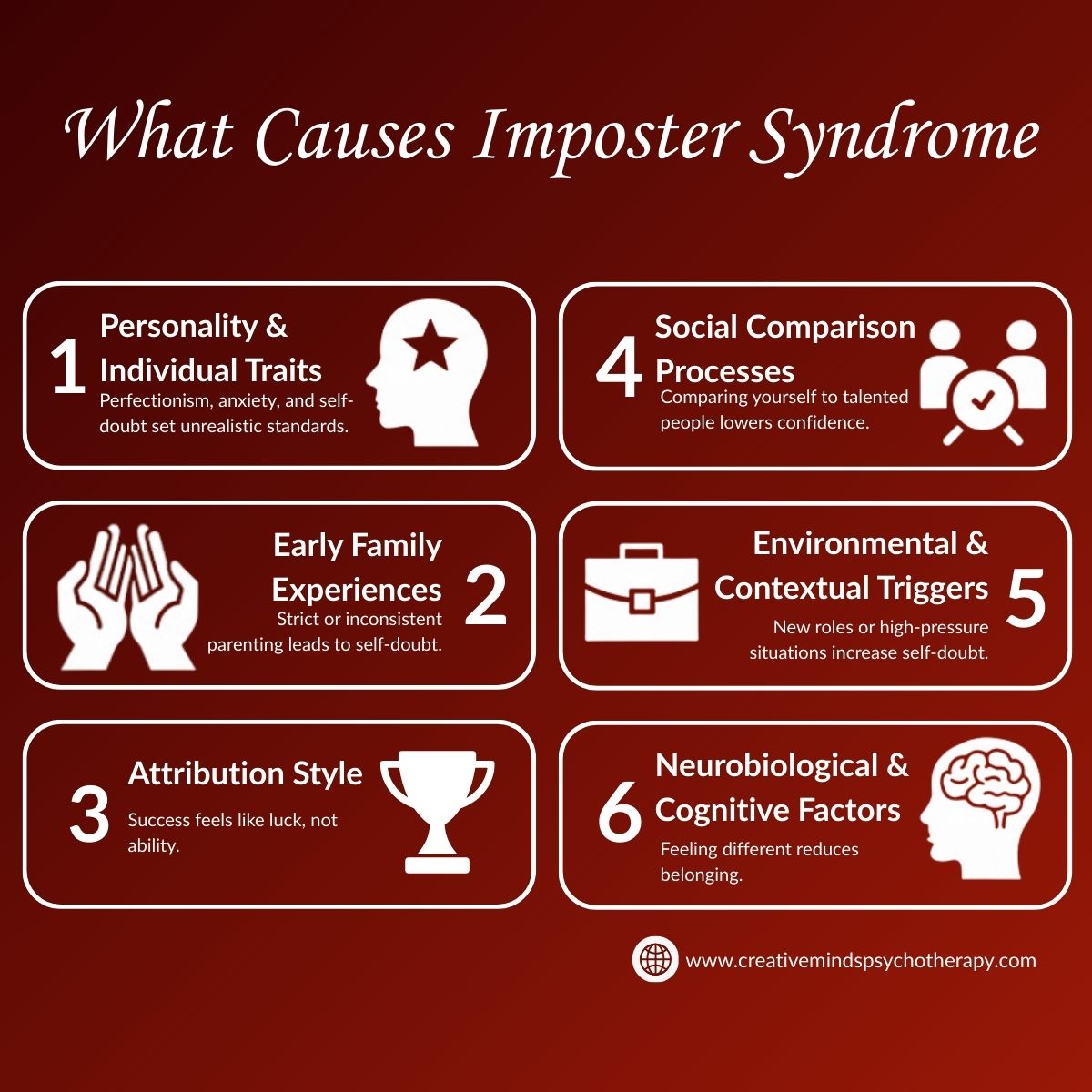
Overcoming self-doubt requires understanding of how the brain, early relational experiences, personality tendencies, dynamics in your career, and broader social environment all shape your internal experience.
These influences overlap, which is why no single explanation captures the full picture. Real change comes from addressing both the inner patterns and the environments that continue to activate and perpetuate them.
If these experiences feel familiar, support can help you move toward a steadier, more grounded sense of confidence. If you’re ready to begin that process, contact me to start the conversation. I specialize in helping creative professionals, entrepreneurs, and high-functioning individuals find peace in the world.
You can finally step into your voice, your talent, your leadership, your creativity – without fear.
You Deserve to Feel Like You Belong in Your Own Life
You deserve to feel at home in your success, to trust your talents and skills, to live from a grounded sense of who you are.
Frequently Asked Questions
How do I know if I’m experiencing Imposter Syndrome?
Imposter syndrome often appears as ongoing self-doubt even when your achievements are clear. You may worry about being “found out,” minimize your strengths, or feel pressure to prove yourself. These patterns usually reflect deeper emotional experiences rather than a lack of competence.
Why doesn’t success make Imposter Syndrome disappear?
Success doesn’t resolve imposter feelings because the uncertainty comes from internal emotional history, not real accomplishments. When early environments shaped your worth around performance or perfection, achievements don’t automatically create safety. Instead, success can activate old fears about being evaluated or falling short.
What causes Imposter Syndrome to develop?
Imposter syndrome often develops from early relational patterns, perfectionism, comparison, unpredictable support, or emotional neglect. These experiences teach you to question your abilities and tie worth to achievement. Later, high-pressure environments or systemic bias can reactivate these same patterns of self-doubt.
Why do high achievers experience Imposter Syndrome more often?
High achievers often work in environments with constant evaluation and comparison, which intensifies existing self-doubt. Because they set high internal standards, even small mistakes can feel significant. Their sensitivity and awareness make them more likely to notice pressure and internalize it.
Can Imposter Syndrome heal?
Yes. Imposter syndrome softens when you understand and shifts the emotional roots of your self-doubt and how those patterns developed. With awareness and support, the nervous system gradually responds differently to success, visibility, and pressure, creating a steadier sense of confidence.

